Description
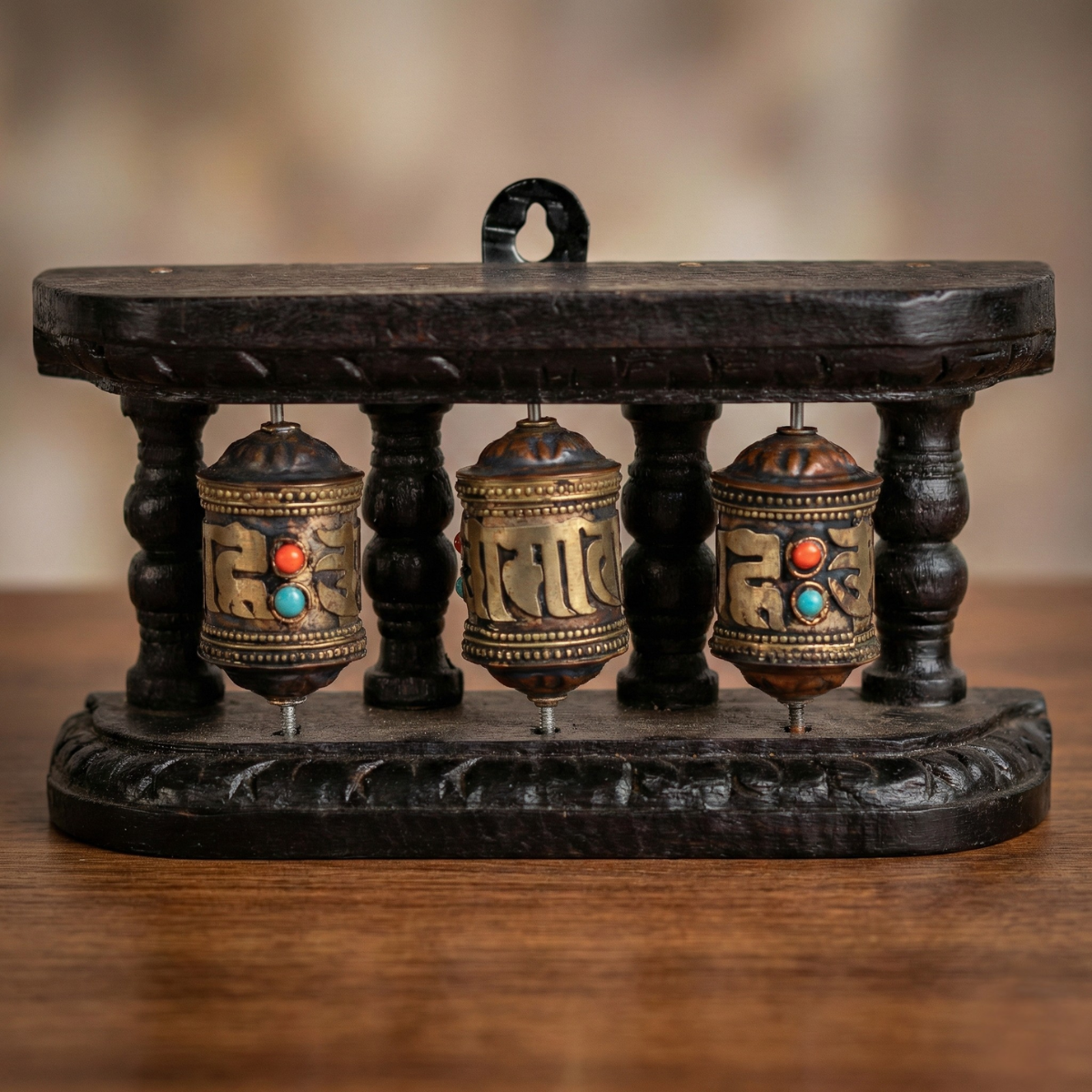
The mani khorlo — Tibetan for “mantra mill” — is among the most widely used devotional objects in Vajrayana Buddhist practice across the Himalayan world. This table-top form presents three brass wheels side by side within a carved wood pavilion frame: a stationary altar-piece that stands on a desk or shelf, or hangs flat against a wall. In Buddhist understanding, each clockwise rotation of a prayer wheel is equivalent to reciting every mantra inscribed inside — three wheels turning together multiplies that accumulated merit threefold with each spin.
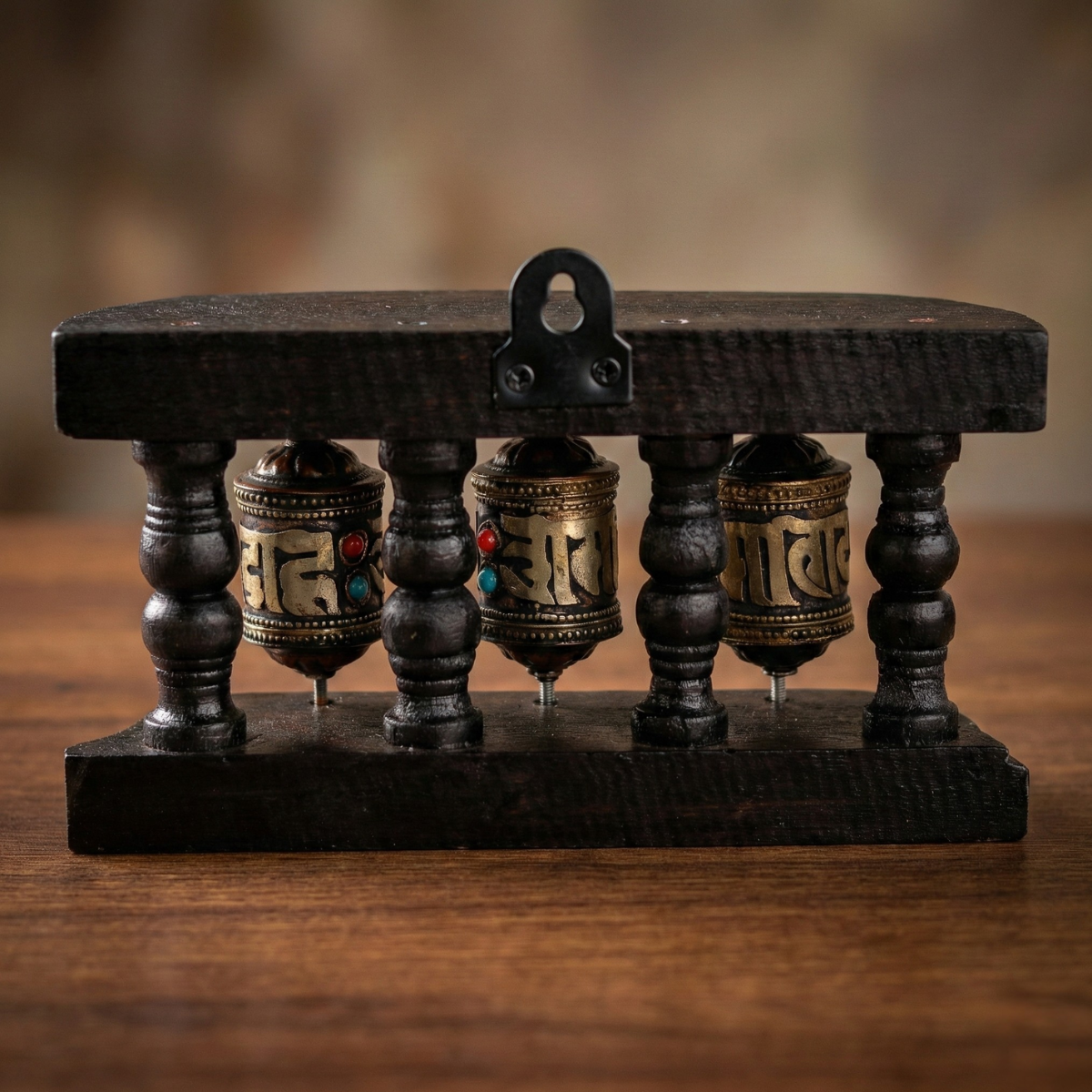
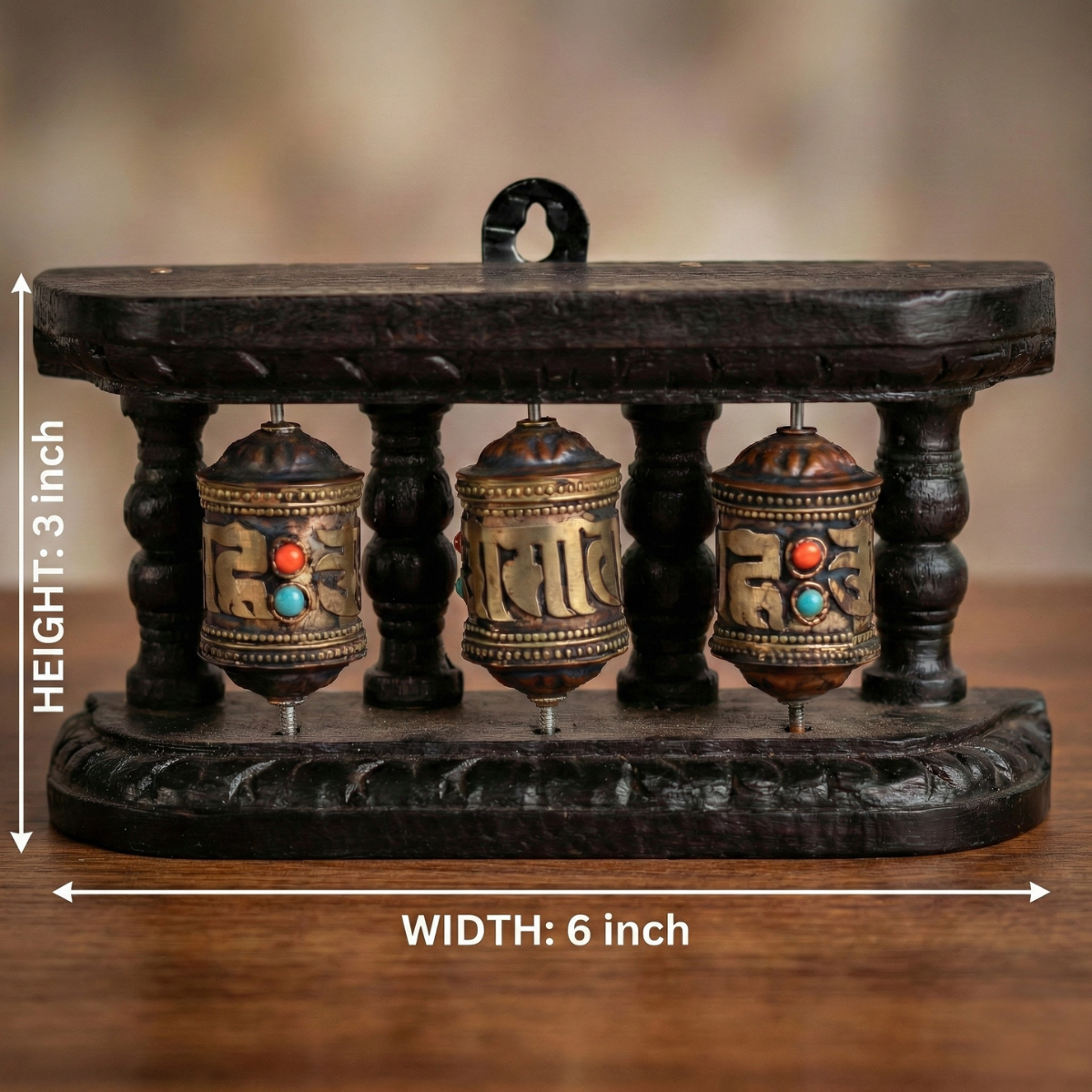
Each of the three brass wheels carries Om Mani Padme Hum — the six-syllable mantra of Avalokiteshvara, the Bodhisattva of Compassion — engraved in Tibetan Uchen script around the full outer circumference, framed within fine beaded borders, with aged copper-brown domed caps. Two stones — coral and turquoise — are set into the body of each wheel; in Himalayan religious metalwork, both materials carry protective and auspicious significance. The carved wood frame — four turned balustered columns on an oval relief-carved base with continuous rope-and-leaf border motifs — draws from traditional Himalayan altar furniture forms. A wall-mount bracket is fitted to the rear, offering vertical placement as an alternative to freestanding use. At 170 g, the assembled piece is compact and settled: 15.24 cm wide, 7.62 cm tall.
On a home altar shelf, a puja corner, or a study desk, this set functions as a devotional anchor — the Om Mani Padme Hum engraving present and meaningful whether the wheels are spinning or still. A considered gift for practitioners establishing a new practice space, or for diaspora families setting up a first home altar. Each piece is sourced directly from artisan workshops in the Eastern Himalayan hills and dispatched from Kalimpong, West Bengal.



Reviews
There are no reviews yet.