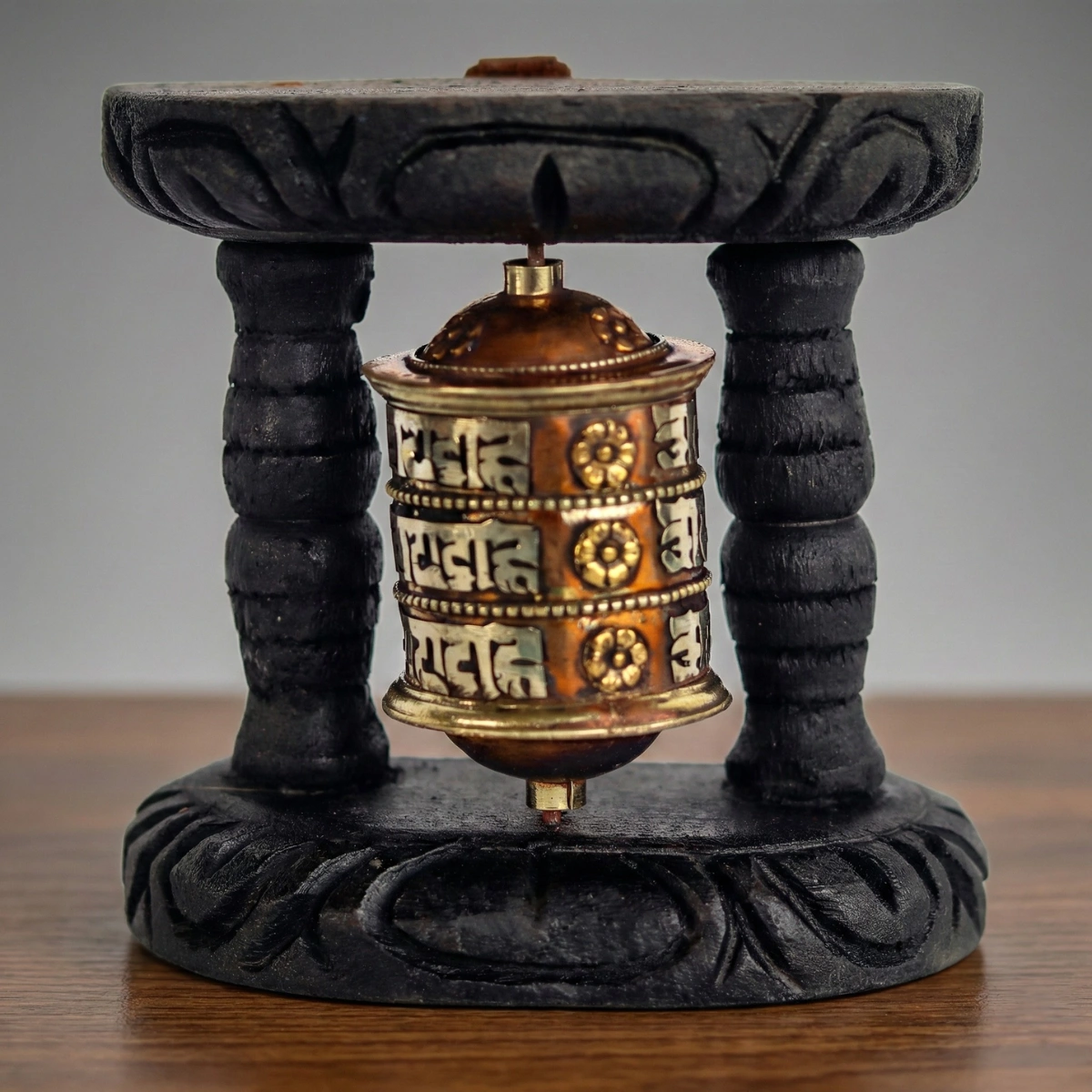
The Tibetan prayer wheel — known as mani khorlo — is among the most widely used devotional objects in the Vajrayana Buddhist tradition, employed by monks, nuns, and lay practitioners across the Himalayan world. Each clockwise rotation is understood as equivalent to reciting aloud every mantra wound inside its hollow cylinder, the wheel functioning as a mantra mill that continuously generates merit and radiates blessings. This table-top form, set on a carved wood stand, serves as a stationary altar piece — to be spun at the opening of a seated practice or placed as a devotional focal point on a home altar or desk.
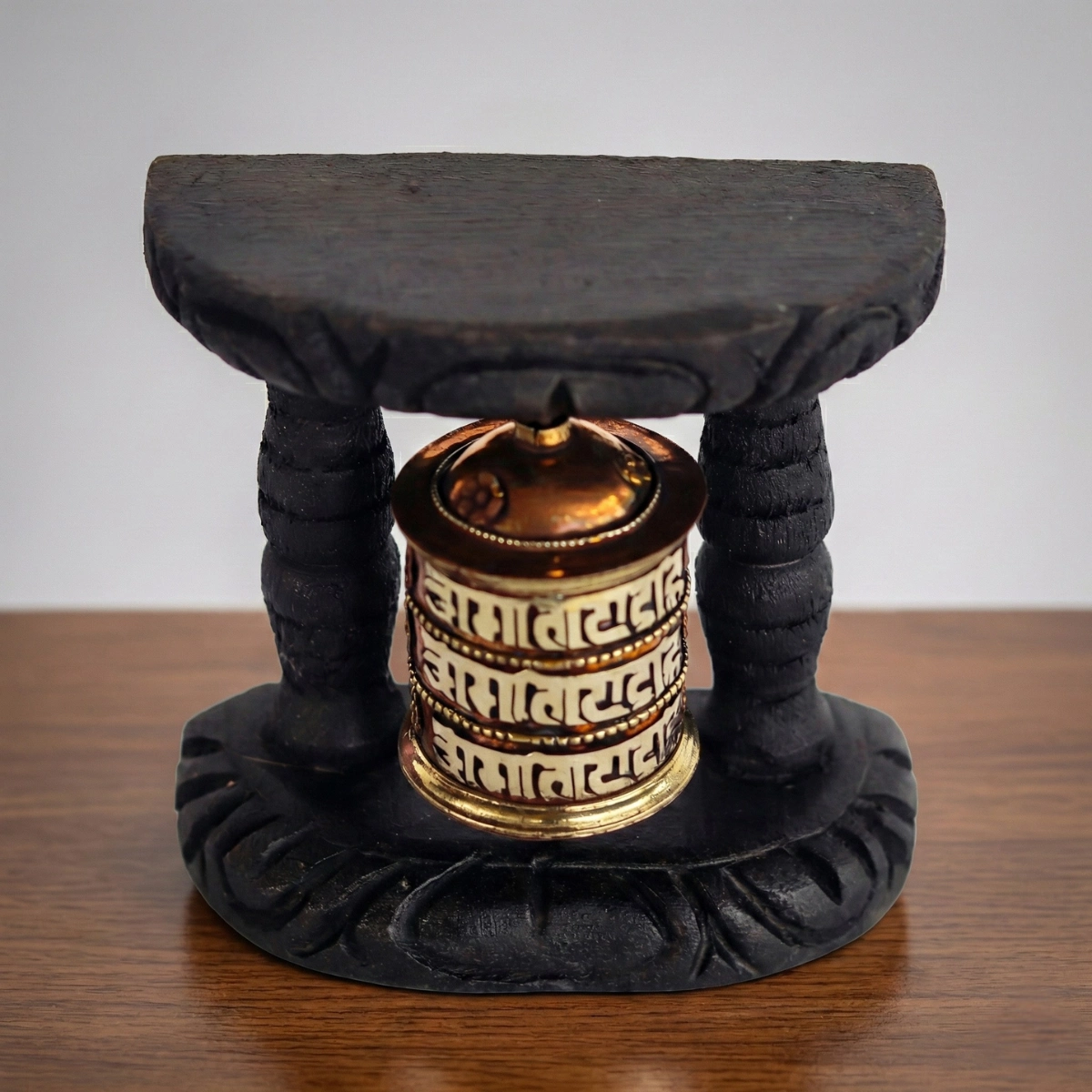
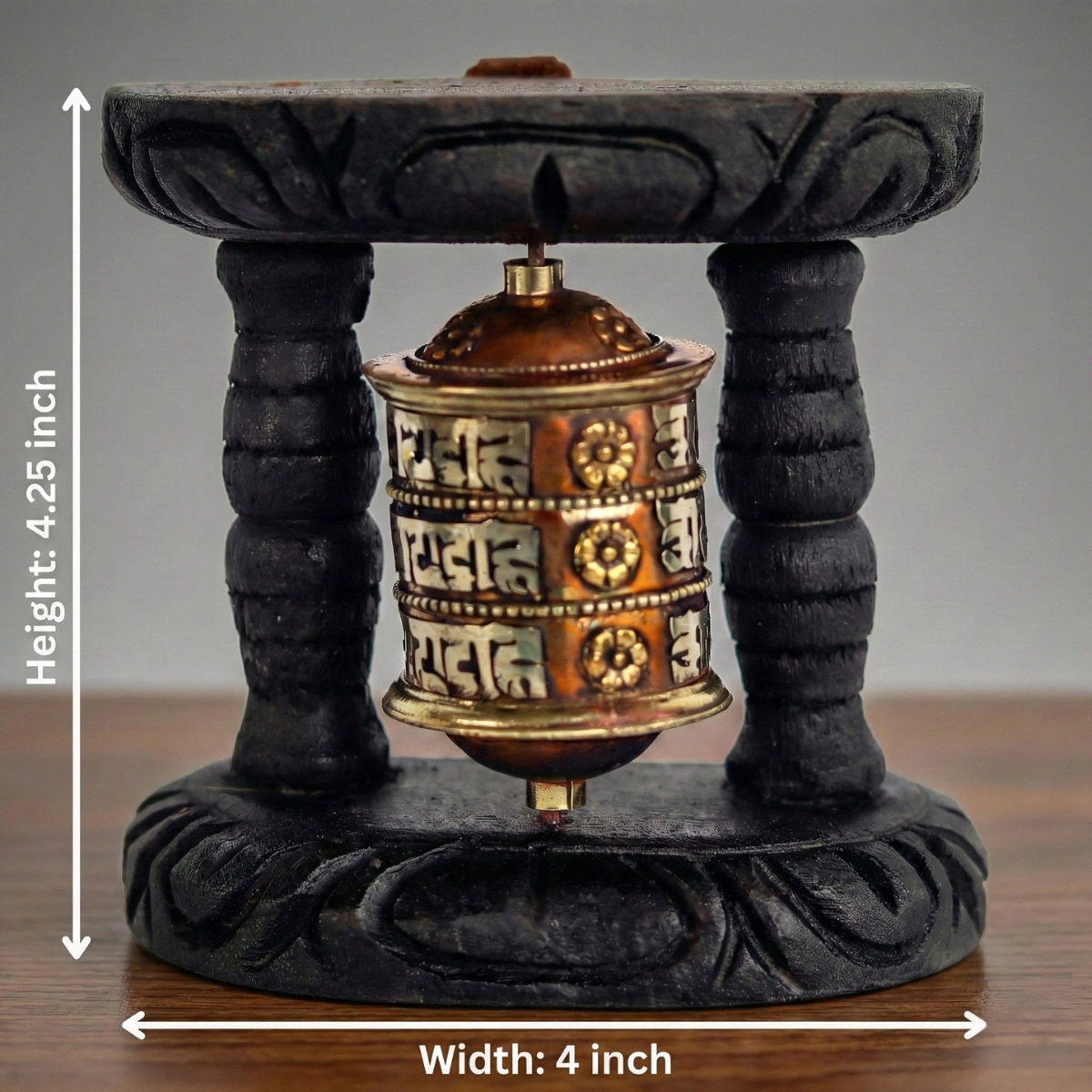
The brass wheel carries Om Mani Padme Hum — the six-syllable mantra of Avalokiteshvara, the Bodhisattva of Compassion — engraved in three horizontal registers of Tibetan Uchen script across the full circumference, with embossed floral rosettes separating each band and fine beaded borders at the edges. The warm copper tone of the wheel sits against the dark carved wood of the stand: an oval relief-carved base, four turned columns, and a canopied top platform, a form drawn from traditional Himalayan altar furniture. The wheel turns on a central metal axle; at 129 g, the assembly has a settled, grounded weight.
On a home altar shelf, alongside an incense burner, or on a desk, the object carries devotional meaning whether turning or still — the Om Mani Padme Hum engraving understood by practitioners as a six-syllable summation of the compassion path. Each piece is sourced from artisan workshops in the Eastern Himalayan hills and dispatched from Kalimpong, West Bengal.