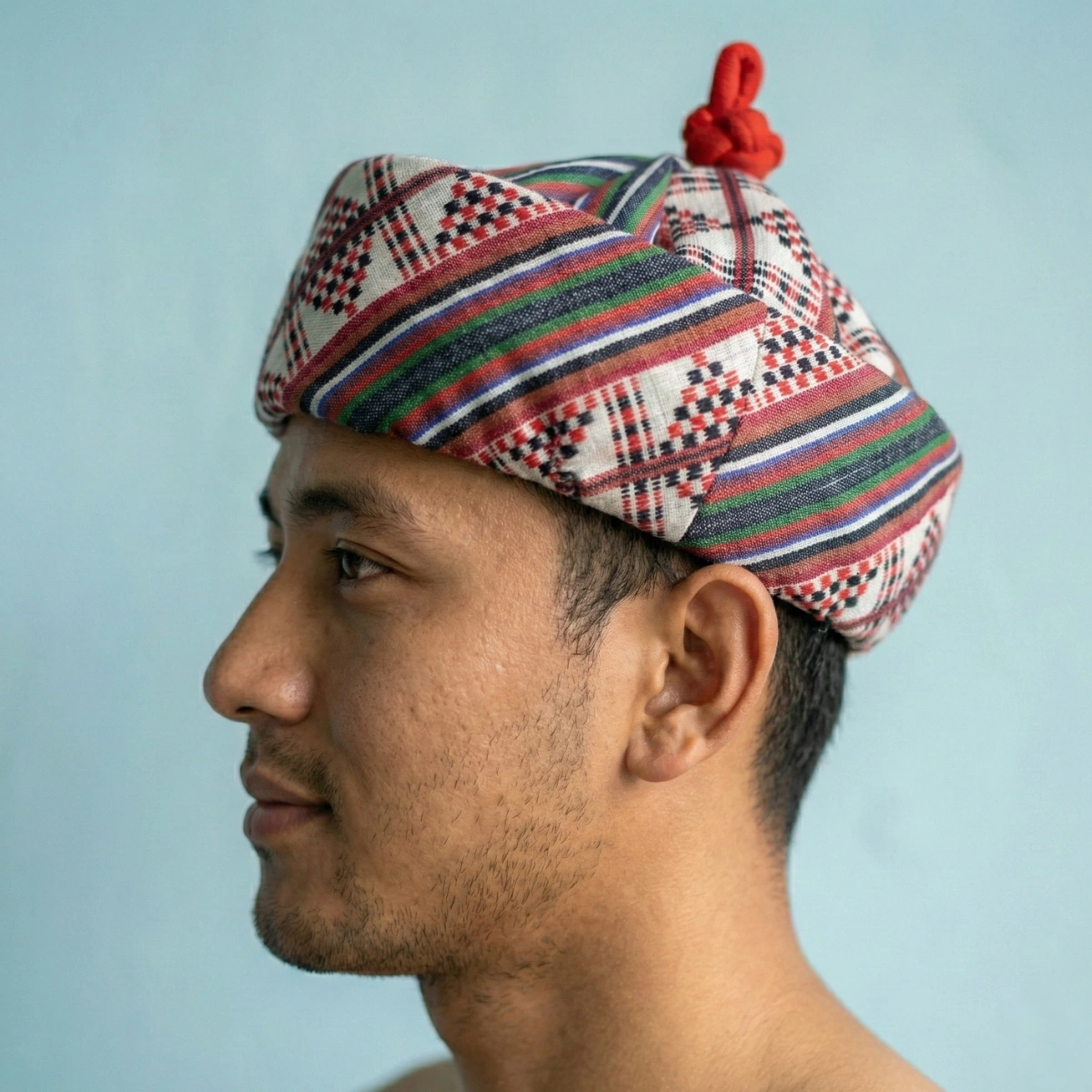
The Lepcha Topi is the traditional men’s headwear of the Rong people — the Lepcha community — indigenous to the Eastern Himalayan hills of Sikkim, Darjeeling, and Kalimpong. Worn as part of a complete traditional ensemble, the topi accompanies the Dumyan robe at Namsoong, Tendong Lho Rum Faat, and the social occasions that mark the rhythm of Lepcha cultural life.
The BHUTIB Lepcha Topi is offered in two distinct styles. The fully woven patterned hat carries traditional interlocking geometric motifs — angular, repeating bands in ochre, maroon, cream, and black — running across the entire surface of the structured poly-cotton crown. The black velvet-rimmed variant retains the same woven crown but finishes the base with a clean velvet band, a contrast that frames the pattern and gives the hat a slightly more formal bearing.
Both styles hold their shape through extended wear while staying light against the head. Lepcha men wear the topi as part of a full traditional dress — paired with the Dumyan — at weddings, festivals, and any occasion where community identity is worn with intention.