Description
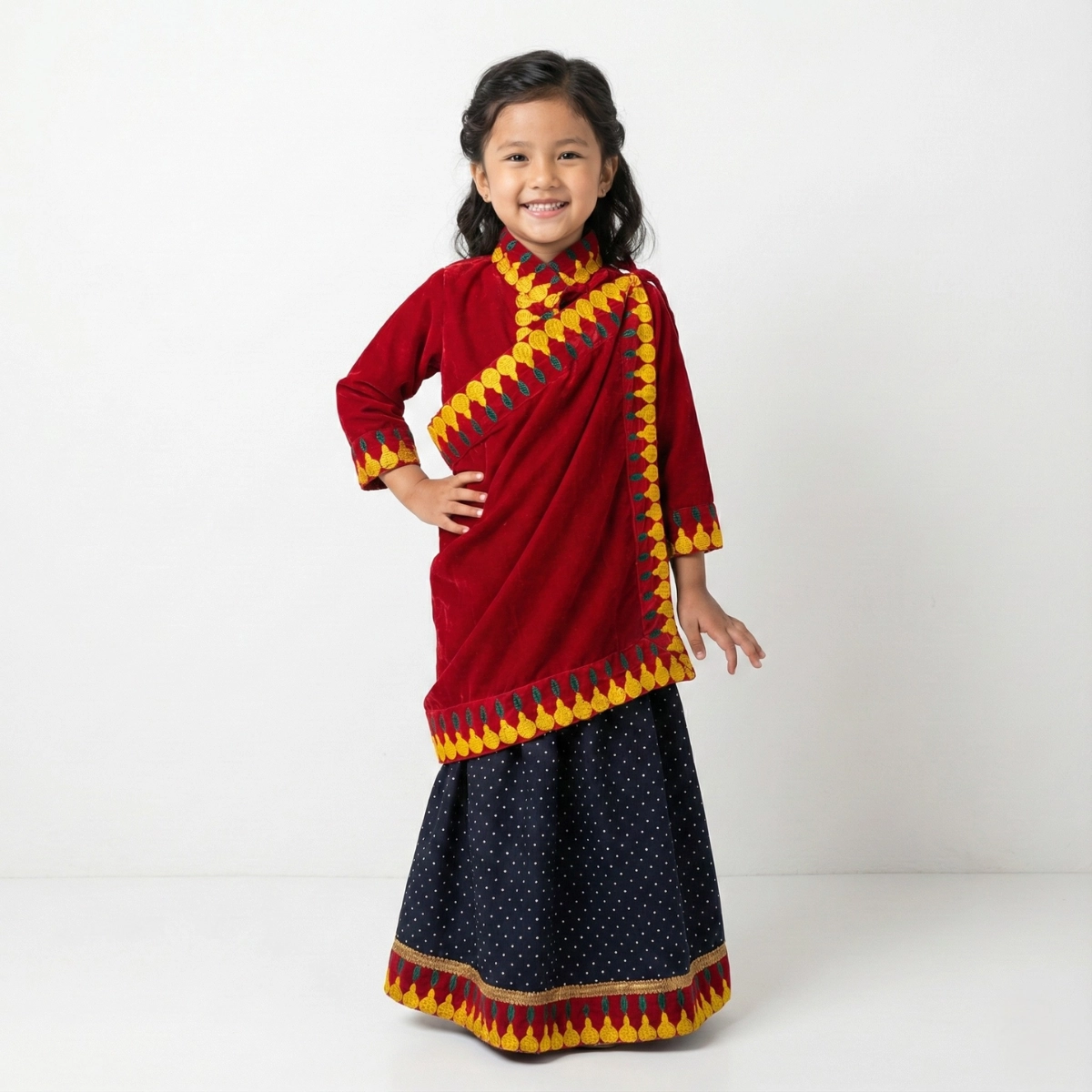
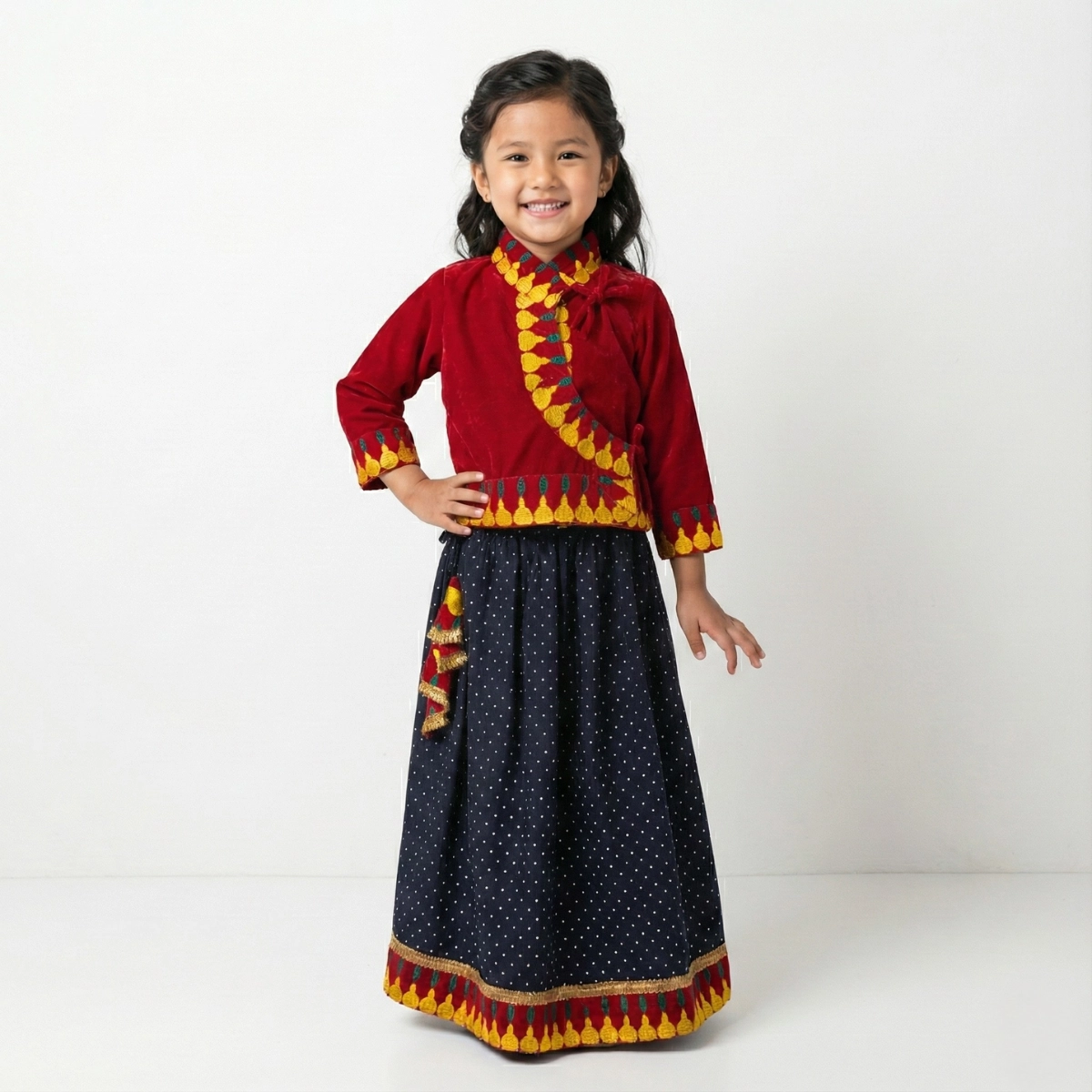
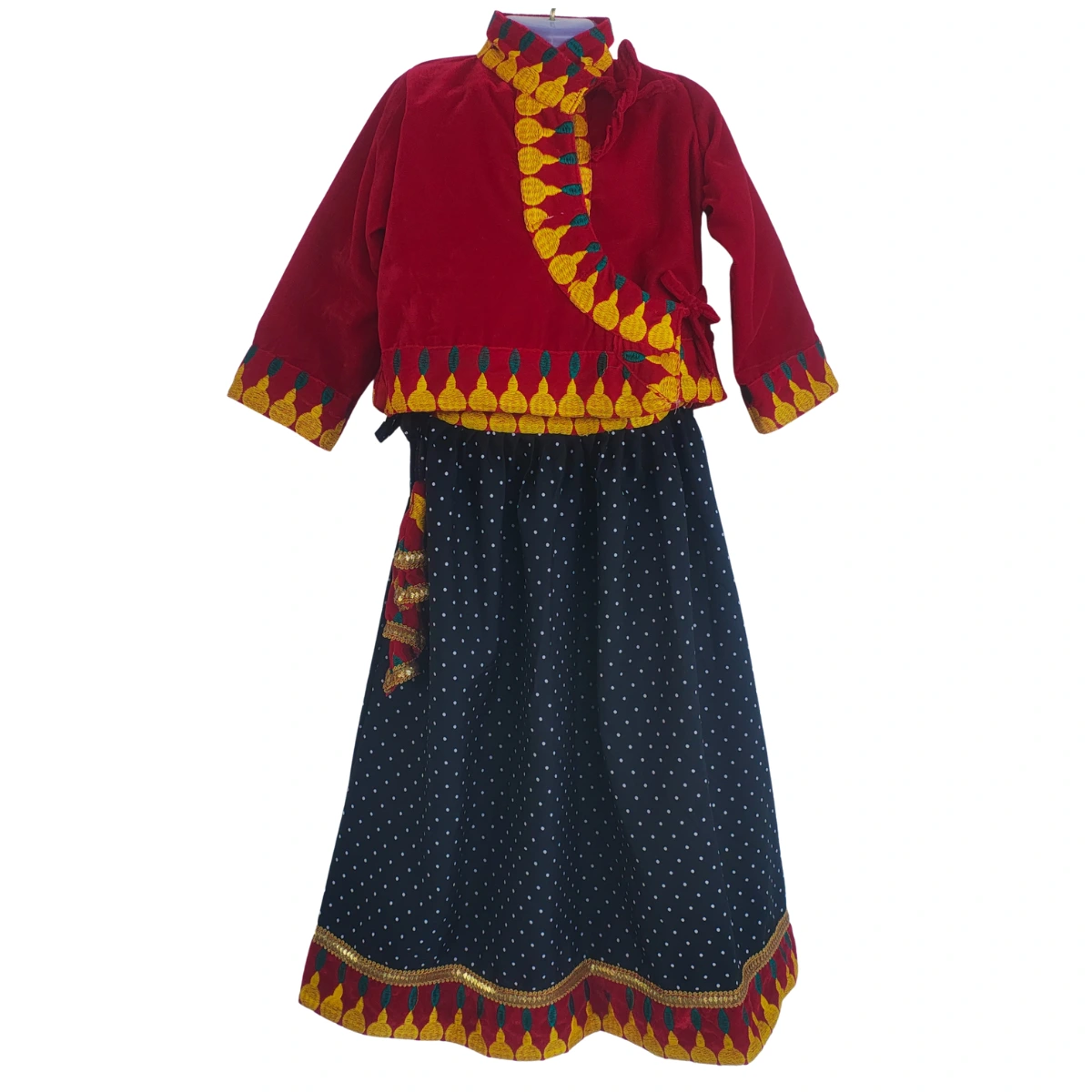
The Rai Lehenga Set is worn by young girls from the Rai community — one of the Kirat peoples of the eastern Himalayan belt — at festivals such as Sakela and Chasok Tangnam, and at cultural programs and community gatherings across Darjeeling, Sikkim, and the Nepali diaspora worldwide. The three-piece set draws directly from the textile vocabulary of Nepali hill communities: a velvet blouse, a flowing lehenga, and a matching ghalek shawl.
The blouse and ghalek are cut from deep red micro velvet — a fabric with a restrained sheen and close pile that holds shape through a full day of wear. The chindu border is the piece’s defining craft element: a repeating sequence of golden yellow kalash motifs with green stitch accents set against a maroon velvet ground, running along the diagonal wrap-over front of the blouse, the sleeve cuffs, and the hem.
The lehenga is navy blue polyester with a white buti dot weave and a matching chindu trim at the hem finished with a gold metallic edging. Young girls wear this set for Rai festivals, school cultural days, and family ceremonies — the ghalek drapes over the shoulder or ties at the side for ease of movement.

Sunita Rai –
Ordered the red colourway for my daughter’s Sakela performance at school — the deep red micro velvet is rich and well-saturated in person, exactly as it appears in the product images. The golden kalash chindu border along the blouse front and cuffs is the detail that made the set stand out among all the other girls on stage.
Anita Limbu –
The three-piece format — blouse, lehenga, and ghalek — is the complete Rai festival set for young girls and having all three pieces tailor-made together meant the velvet tones matched perfectly across all three. The ghalek drapes easily over the shoulder and the tie at the side keeps it in place through active movement.
Kopila Gurung –
The lehenga hem chindu trim with gold metallic edging is beautiful but the gold thread at the very edge caught slightly on rough surfaces during an outdoor Sakela event. Not a defect, just worth knowing for events. The velvet blouse and ghalek are both very well made.
Bina Rai –
The navy blue polyester lehenga with white buti dot weave is an interesting fabric choice — the dot pattern is subtle and gives the lehenga surface some texture that plain navy wouldn’t have. Against the deep red velvet blouse and ghalek the colour contrast is bold and festive.
Pratibha Sherpa –
My niece wore the maroon colourway for a Chasok Tangnam celebration — the maroon velvet reads as deeper and more formal than the red, which suited the occasion well. The chindu kalash border motifs were commented on specifically by older Rai community members at the event.
Rekha Limbu –
The diagonal wrap-over blouse front with side tie is the traditional Rai blouse construction and this version gets it right — the tie sits securely at the side without requiring constant readjustment, and the diagonal front gives the chindu border a clear line to follow across the chest.
Sujata Rai –
The golden yellow kalash motifs in the chindu border are clearly defined and evenly spaced — the repeat is consistent from the collar down through the diagonal blouse front and continuing to the sleeve cuffs. That pattern continuity is what makes the embroidery read as intentional craft rather than decoration.
Gita Rai –
My daughter has worn this set for Sakela every year since she was six — this is the second set we have ordered and the quality is consistent between both. The micro velvet holds its pile and the chindu border retains its colour through careful hand washing across multiple festival seasons.
Meena Gurung –
The green stitch accents within the golden kalash chindu border add a subtle layer of colour detail that is easy to miss in product photographs but immediately visible in person — the three-colour border of gold, green, and maroon ground is more complex than it first appears.
Sarika Rai –
For Rai girls at school cultural programs in Darjeeling and Sikkim, the three-piece lehenga set is the standard traditional dress and this version of the set is made correctly — the velvet quality, the chindu border, and the navy lehenga with buti weave all align with what older community members expect to see.
Kabita Limbu –
The lehenga flows well — the navy polyester with buti dot weave has enough body to hold a full skirt silhouette without needing a petticoat underneath, which makes it easier to manage for young girls during a full day of festival activities.
Puja Sherpa –
Delivery took about eleven days.
Durga Rai –
The micro velvet is soft enough that my daughter wore the blouse comfortably through a full outdoor Sakela celebration without any discomfort at the collar or cuffs — velvet against a child’s neck and wrists can sometimes cause irritation but the pile on this fabric is fine enough to avoid that.
Sabina Gurung –
The ghalek shawl in matching red micro velvet completes the three-piece set in a way that a plain shawl never would — having all three pieces in the same velvet with coordinating chindu border trim makes the set read as a considered traditional ensemble rather than a mix of separate items.
Sunmaya Rai –
Ordered the red colourway for Chasok Tangnam and the maroon colourway for Sakela in consecutive seasons — both arrived correctly made and the colour matching across blouse, lehenga, and ghalek was accurate within each set. Consistent quality across two orders.
Tara Limbu –
The chindu border at the lehenga hem with gold metallic edging is the final detail that finishes the skirt correctly — a plain hem would have left the lehenga looking incomplete relative to the embroidered blouse. The gold edge catches light nicely when my daughter moves during dance.
Kamala Rai –
The buti dot pattern on the navy lehenga is subtle enough that it reads as texture rather than pattern from a distance. The overall colour combination of red velvet and navy lehenga is very striking.
Hira Sherpa –
My granddaughter wore this set for her first Sakela festival — seeing her in the correct traditional Rai three-piece dress for the first time was meaningful for our whole family. The set is made with the kind of care that makes it feel like a genuine cultural garment rather than a costume.
Laxmi Rai –
The diagonal wrap-over blouse front is easier for children to manage than a center-front button closure — my daughter can adjust the side tie herself without assistance, which gives her independence during school performances where parent help isn’t always available backstage.
Manju Gurung –
The deep red micro velvet of the blouse and ghalek is consistent in colour saturation across both pieces — no visible variation in dye depth between the two garments, which is important when the ghalek drapes over the blouse and both are visible simultaneously.
Rekha Tamang –
For Rai families living in Kalimpong, Siliguri, and across West Bengal, this set represents one of the few ways to source a correctly made traditional girls’ festival dress without travelling to Nepal or relying on local tailors who may not know the specific Rai construction details.
Sunita Limbu –
The ghalek is slightly longer than I expected relative to my daughter’s height — it drapes to about mid-thigh on a seven-year-old which is a generous length. This is traditional and correct but worth noting for younger or smaller children where the drape may feel unwieldy at first.
Anita Rai –
The golden yellow kalash motifs in the chindu border have a warmth and weight that contrasts beautifully with the deep red velvet ground — the motifs are neither too dense nor too sparse along the diagonal blouse front, giving the border room to read clearly as a distinct craft element.
Bimala Sherpa –
My daughter wore this set for three consecutive Sakela celebrations at her school in Darjeeling — the micro velvet has held its pile across three years of careful storage and one hand wash per season. Durable quality for a garment meant to mark important cultural occasions in a child’s life.